I’ve tried my hand at a lot of different skills, baking, brewing, sewing, and one thing I always thought would be interesting is to try CHEESE-MAKING! This past weekend, I was at the Mid-America Homesteading Conference in Joliet, Illinois. Among the many presentations was a cheese making demonstration by Mike Boehle. In it, Mike makes mozzarella from scratch and also discusses the history of cheese, tips and tricks, and plenty of other beginner cheese making knowledge as he does. He allowed me to video-record the presentation. Here is that presentation in its entirety.
One reason why I haven’t ever tried making cheese before is due to the lack of supplies. Cheese making requires a few ingredients most people don’t keep handy in their kitchen, including rennet. At the conference, there were some basic cheese supplies available at the bookstore, so I picked some up.
Back home the next day, I thought I would give it a shot. I bought one gallon of whole milk from the grocery store. It was nothing fancy, but I made sure to check that it didn’t say “Ultra-Pasturized” anywhere on it. In my kitchen, I broke out my favorite pot, a Lodge enameled cast iron, poured the milk in, and started bringing it up to temperature.
I followed the steps I learned in the presentation, adding the citric acid, raising the temperature some more and then adding the rennet.
 It’s pretty interesting once the curds start forming. I must admit that the reason I enjoy baking over cooking is that it is ALCHEMY. Sure cooking involves a little chemistry, but baking is pure magic. In the same way, milk transforming into curds surely involves some sort of incantation that browning some beef never will.
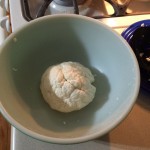 Once the curds separated out, I poured off the whey and set the curd into a glass bowl, where I kneaded it like bread dough to get a little more whey out.
Next came microwaving it. Heating the curd gets it stretchy. I ran the microwave for a minute, then stretched the cheese. Surprisingly, I had to get the cheese rather hot before it was stretchy. Have you even eaten really hot pizza only to have the cheese stretch out, then snap and hit you on the lip burning you? Yeah, like that hot. It might be that since this was my first ever batch of cheese it didn’t turn out perfect, and thus effected the melting point. Other than going “ow ow ow”, I stretched and heated the cheese a few times, then formed it into a ball and dropped it into a bowl of ice-water to cool.

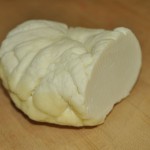 My one gallon of store-bought whole milk made 13 oz of mozzarella cheese. The next day, I sliced off a piece and tried it. It was firmer than I expected it to be. Perhaps I eliminated TOO much whey? The flavor was very simple. I just tasted like milk. Although the recipe didn’t call for it, I might try adding a little salt next time. Mike makes his from farm-fresh goats milk, which certainly has a stronger flavor than pasteurized/homogenized cow milk.
Of course, what good is making any ingredient until you use it! I was eager to try making a dish with this fresh mozzarella. While we are extremely lazy gardeners, we do have a few tomato plants going, and I picked a few fruits. We also have a little herb patch right outside our front door, and had basil handy. That means I was all ready for Caprese Salad!
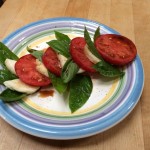 I sliced tomatoes and mozzarella and laid them out on a plate with basil, salt, pepper, olive oil, and balsamic vinegar. This dish always looks nice with its bright colors, but tastes even better with its bold flavors.
I’ll definitely have to keep experimenting with cheese. It’s not hard, and it’s pure food magic!
Til next time, keep making something of yourself!
-Ben
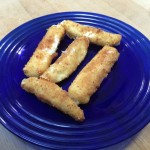
PS: I did a melt test and found that my very first batch of mozzarella actually melts pretty well. So, that quickly lead to me making a batch of DIY deep-fried cheese sticks! Delish!